



Franchise Valuation: How Is a Franchise Actually Valued?
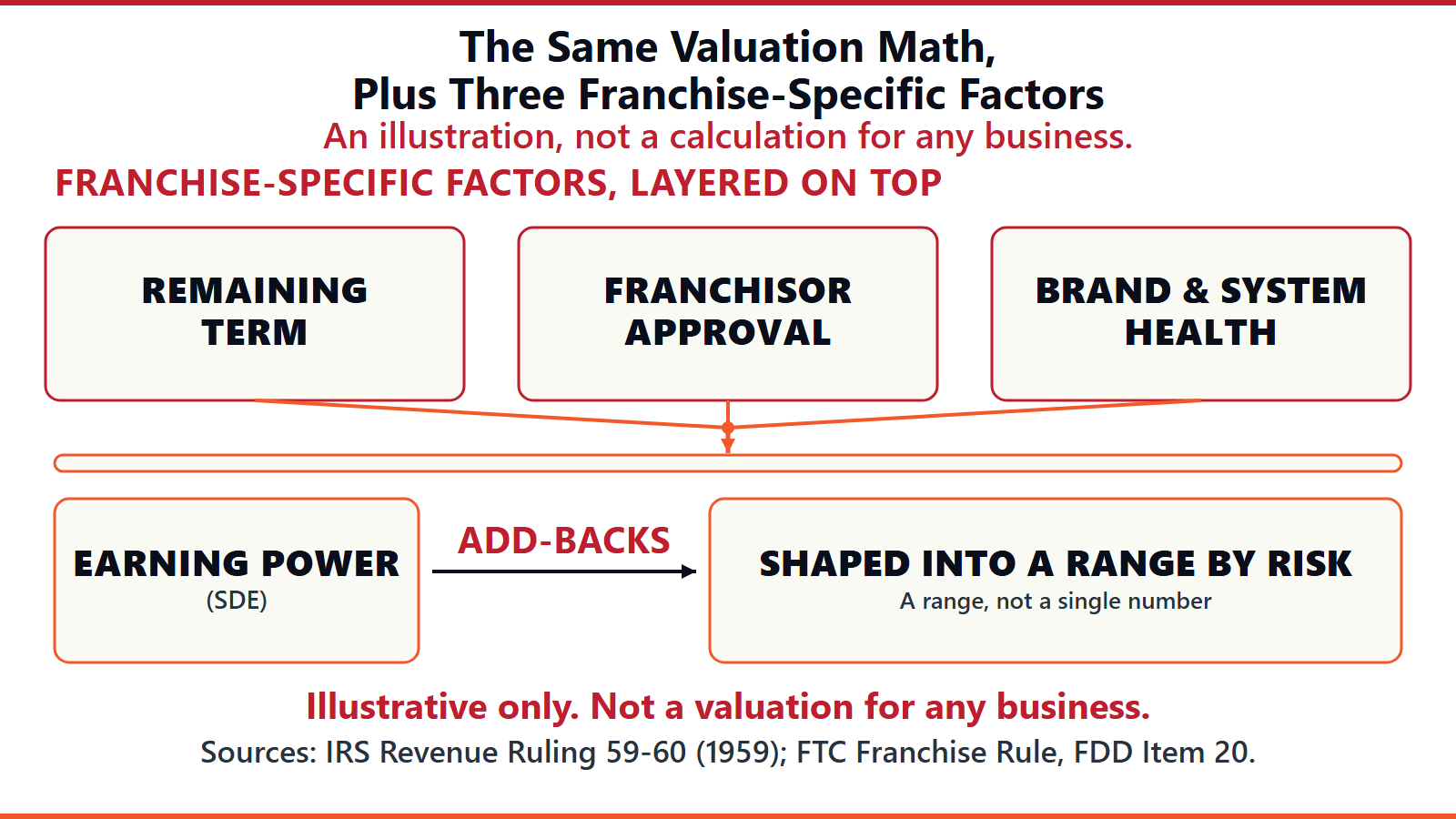
If you own a franchise and want to know what it is worth, a buyer will price what the business can earn for them, starting from your real earning power and adjusting for risk. Franchise valuation begins with the same math any small business uses. It then adds three questions only a franchise buyer has to ask: how long your franchise agreement still runs, whether your franchisor has to approve the sale, and where your brand is heading. You probably already carry a number in your head. This article shows where that number meets the one a buyer will bring.
Why is my number different from what a buyer will pay?
Because you and the buyer are answering different questions. You are counting what the business has cost and meant to you over the years. The buyer is counting what it can return to them, with no guarantee and no second chance if they are wrong.
The number in your head probably comes from somewhere real: what you put in, what you need the proceeds to fund next, or what another franchisee in your system got. Each of those is a fair starting point for a conversation with yourself. None of them is how a buyer prices a business.
The Internal Revenue Service's Revenue Ruling 59-60 (1959), written for valuing closely held company stock, defines fair market value as the price at which property would change hands between a willing buyer and a willing seller, neither under compulsion to act and both with reasonable knowledge of the relevant facts. A sale forced by a deadline or a burnout date sits outside that definition, which is one reason to start before you have to.
What is the real earning power of my franchise?
It is your profit once you add back what a new owner would not have to carry. The industry calls the result seller's discretionary earnings, or SDE.
Your tax return understates what the business pays an owner. A vehicle, personal expenses and a one-time bad year all sit in your costs, and a buyer does not inherit them. Rent paid to your own LLC gets restated at market rate. Pulling these items out and putting related-party payments at market is what turns a raw profit and loss statement into a number a buyer can trust.
SDE is a measure built for owner-operated businesses, because it adds back the owner's pay. EBITDA does not add back the owner's pay, so it fits businesses large enough to employ a manager in your seat.
What makes valuing a franchise different from valuing an independent business?
Three things a buyer, and a lender if one is involved, will ask about that an independent sale never raises: the time left on your franchise agreement, your franchisor's approval of the buyer, and the health of your brand as a system.
How much time is left on my franchise agreement?
The fewer years you have left, the harder a buyer looks at whether the agreement will be renewed and on what terms. Item 17 of the Franchise Disclosure Document (FDD) has rows for the length of the term, for renewal, and for what you must do to renew (16 CFR 436.5(q), read on Cornell Law School's Legal Information Institute, 2026-10-26).
If you have four or five years left and no renewal conversation has started, expect that to come up before price does. A buyer who is borrowing to buy will also find that the lender wants to see how the remaining term lines up with the loan.
Does my franchisor have to approve the buyer?
Yes, your buyer has to clear your franchisor, and some agreements also give the franchisor a right of first refusal, which lets it step in and buy on the same terms. An independent business has no franchisor with a say over who buys. You do, and a buyer weighs that as closing risk alongside your numbers.
The approval right is a term of your franchise agreement. The FTC's Franchise Rule makes the franchisor disclose it: Item 17 has rows for whether approval is required, the conditions, and any right of first refusal (16 CFR 436.5(q), same reading). We found no public study that measures how long approval takes, so we give no day count. Your own agreement and your attorney answer this one for your franchise.
How is my brand doing as a system?
A buyer can read how your brand is trending, because the franchisor must report it. Item 20 of the FDD discloses outlets opened, closed and transferred across the franchisor's last three fiscal years (16 CFR 436.5(t), same reading).
A shrinking system softens a buyer's confidence even when your own unit looks strong. You cannot change your brand's numbers, which is why a buyer will weigh them separately from yours.
Why can two franchises with the same earnings sell for different prices?
Because buyers pay more for the safer business. Two franchises with identical earning power land at different points in their range, and the reasons are specific:
- Customers are spread out. No handful of accounts carries the revenue.
- The business runs without you. It does not stall if you step away for two weeks.
- Revenue repeats. It does not reset to zero each month.
- The financials are clean. Several years of books are ready on request.
- Staff are likely to stay through the transition.
Revenue Ruling 59-60 says that "no standard tables of capitalization rates… can be formulated" for a closely held company. That is the IRS's own 1959 view that a valuation has to weigh your particular business, and it is why we do not print a multiple in a blog post.
Most of this list is yours to change. You can clean up the books, document how the business runs without you, and open the renewal conversation with your franchisor before a buyer asks about it.
Can an online franchise valuation calculator tell me what mine is worth?
It can give you a rough sense of scale, and nothing you should negotiate from. A calculator that takes only your revenue and perhaps an industry code returns a number from those inputs alone.
The same ruling lists judgment-based factors an appraisal weighs, including the nature of the business, its economic outlook and its goodwill. A generic tool cannot weigh those. It also has no way to ask about your remaining term, your franchisor's approval process or your system's health, because it does not know franchising works differently.
How do I find out what my franchise is worth?
Request a free Opinion of Value. It gives you a personal valuation page with a custom video walkthrough recorded by a senior advisor. You can watch it on your own time.
When you are ready to talk about what comes next, our pages on how to sell a franchise and on the sale process cover the steps. To start with the number, request your free Opinion of Value.
Frequently asked questions
No, you can start the request without them. A full valuation usually draws on your financials, and tax returns and profit and loss statements are standard in this industry, so having them to hand helps once the work begins.
No. The Opinion of Value is completely free, with no card on file and no follow-up sales pressure.
The buyer who pays for it, in the end. A valuation estimates where a qualified buyer is likely to land, which is why it weighs the same risks a buyer does.