



How to Get Out of a Franchise Agreement: Your Real Options
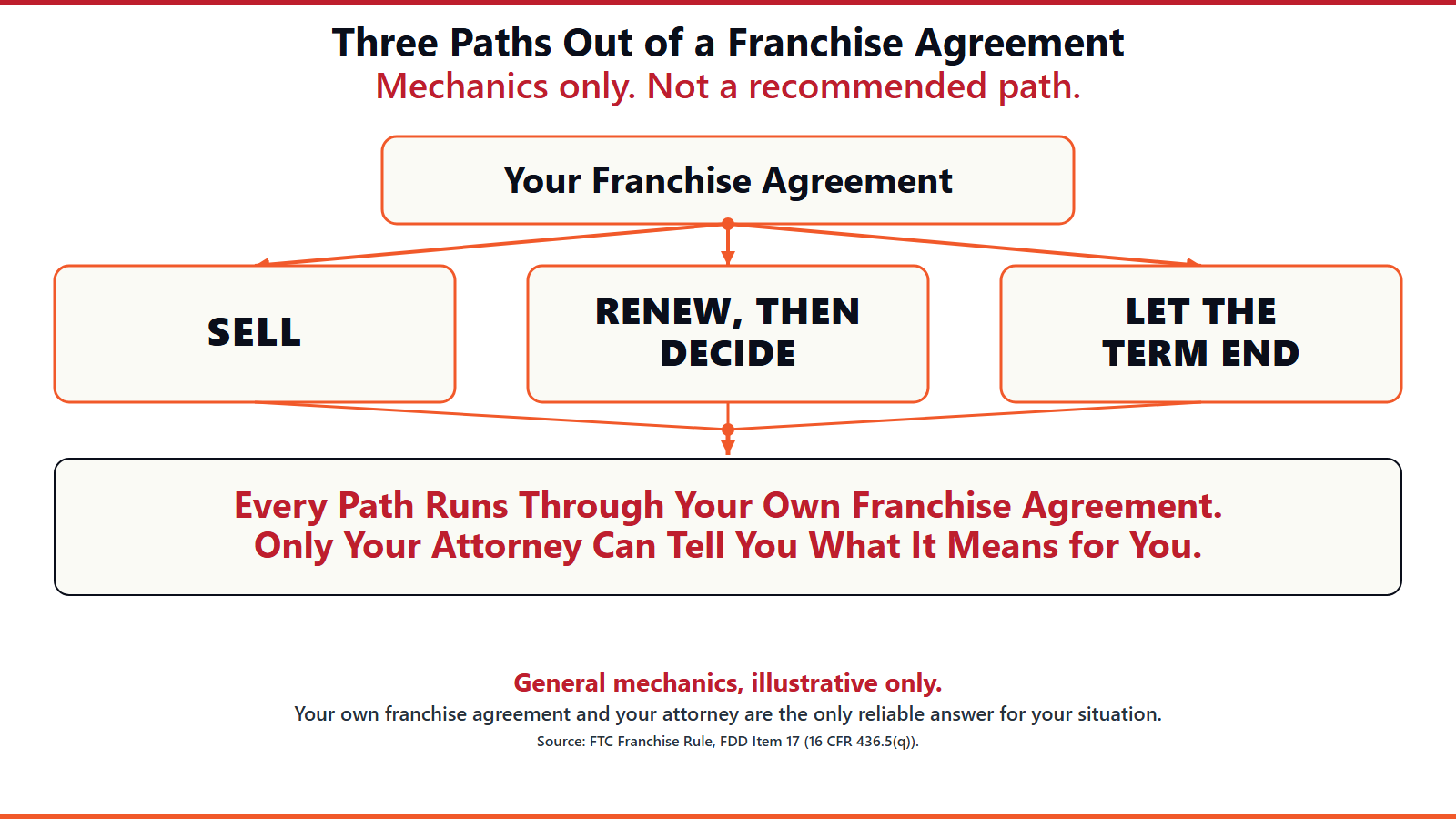
If you are searching for how to get out of a franchise agreement, you are probably asking whether you are stuck. You have options. There are three real ways out: sell the franchise, renew and decide later, or let the term run to its end. Each one runs through a gate you will have to clear, and the most common gate for a sale is your franchisor's approval of the buyer. This article covers how those mechanics generally work. It does not tell you what your own agreement says.
Do I have to sell to get out of my franchise agreement?
No. Selling is one of three paths, and it is often the last one an owner considers. The other two are renewing first and deciding later, and riding out the remaining term.
Item 17 of the Franchise Disclosure Document (FDD) is where your franchisor has to lay out the term, renewal, termination, transfer and what you owe when the relationship ends (16 CFR 436.5(q), read on Cornell Law School's Legal Information Institute, 2026-10-26). It is a summary table that points to the sections of your agreement, so your own agreement and your attorney hold the real answers.
If I sell, does my franchisor have to approve the buyer?
In almost every case, yes. Finding a buyer and agreeing on a price does not close the sale by itself, because the franchisor reviews the buyer against its own standards first.
Item 17 has a row for whether the franchisor must approve a transfer and another for the conditions it applies (rows (l) and (m), 16 CFR 436.5(q), same reading). A buyer may be asked to sign the agreement the franchisor is offering today, not a copy of yours. If you negotiated a lower royalty or older terms years ago, those may not carry over, which is one reason your number and a buyer's number can differ.
You control the preparation. Read the transfer clause now, ask your franchisor in writing what its approval process requires, and do it before you have a buyer at the table.
Does "sole discretion" mean my franchisor can refuse any buyer?
Not always. If your agreement lets the franchisor refuse a buyer "in its sole discretion," your state may replace that wording with an objective test. Whether yours does is a question for your attorney.
Some states have their own franchise relationship laws, separate from the federal FTC Franchise Rule. Minnesota's calls it "unfair and inequitable" to "unreasonably withhold consent" to a sale when the buyer meets the present qualifications and standards required of the franchisor's franchisees (Minnesota Statutes section 80C.14, subdivision 5). California's Franchise Relations Act takes a similar objective approach and adds a clock: once a transfer application is complete, the franchisor has 60 days to approve or deny it in writing (California Business and Professions Code sections 20028 and 20029). We read both statutes in earlier research from the state sources and did not reopen them for this article, so check the current text or ask your attorney before relying on either.
Not every state has such a law. Where none applies, the contract wording may be the whole answer. We do not have a verified count of which states do and which do not, so we give none.
Does selling end my personal guarantee?
Maybe not, and it is worth finding out before you have a buyer. If you borrowed to buy your franchise, you may have signed a personal guarantee to the lender, and your franchise agreement may carry a separate guarantee of its own obligations.
A guarantee to a lender is generally tied to that debt, so your lender's payoff terms and your attorney are where to confirm what paying the loan off at closing does to it. One inside the franchise agreement is generally tied to your obligations under that agreement. We found no public source stating that closing a sale ends it, so treat it as an open question until your franchisor releases it in writing.
Ask your franchisor whether it has ever released a personal guarantee in your system, and have your attorney read what your agreement requires. Item 17 also has a row for what you must do on termination or non-renewal (row (i), same reading).
Can my franchisor step in and buy instead of my buyer?
If your agreement includes a right of first refusal, yes. It lets the franchisor take the business on the terms your buyer negotiated, before your buyer closes. It is one of the rows every FDD has to address (row (n), 16 CFR 436.5(q), same reading).
Some agreements include the clause. We found no source that says how often franchisors actually use it, so we give no rate. You can plan for it anyway. A purchase agreement with clear timing and contingency language can help you avoid starting over with a buyer who has already walked. Whether your agreement includes this right, and how it is worded, sits in your document.
Should I renew before I sell, or sell with the term still running?
It is a tradeoff, and the answer depends on how much term you have left. Both choices are yours to make.
Renewing first gives a buyer a fresh term to finance against. You take on whatever the new agreement costs, which may include remodel obligations, for a term you may not want to operate under yourself. Selling with the clock running avoids the renewal cost. A buyer's lender will weigh a shorter remaining term, and no published rule says how short is too short.
Item 17 has rows for renewal and for what you must do to renew (rows (b) and (c), same reading). Raise renewal terms with your franchisor well before you plan to list.
How do I get out without selling?
Three other endings exist, and each one ends the relationship without a buyer. You can let the term run out, decline to renew, or leave through a termination, which is usually a default and carries its own consequences.
Walking away before your term ends is generally treated by the agreement as a default or early termination, and that can trigger what the contract says about leaving the brand and paying amounts still owed. Item 17 has rows for your right to terminate, your obligations when the agreement ends, and non-compete covenants during and after the term (rows (d), (i), (q) and (r), same reading). A non-compete can limit what you do next, so read that clause first. The controlled versions are riding out the term or declining to renew when it ends.
What should I find out before I decide?
What the business would bring. Without a number it is hard to compare selling to staying put. Our article on how a franchise is valued shows what drives it.
To start with the number, request a free Opinion of Value. It is a personal valuation page with a custom video walkthrough recorded by a senior advisor. When you are ready to look at the sale itself, our pages on selling a franchise and the sale process cover the steps. Whatever path you choose, request your free Opinion of Value first. It costs nothing and commits you to nothing.
Frequently asked questions
Not without consequences. Leaving before the term ends is generally treated as a default or early termination, and your agreement says what follows. Riding out the term or not renewing are the controlled ways to leave.
Possibly. A guarantee inside the franchise agreement is separate from any loan guarantee, and we found no public source saying a sale ends it. Ask your franchisor to confirm a release in writing before you have a buyer.
A court applying your state's law, so your attorney is the person to ask. The answer turns on whether your state has a franchise relationship statute that covers transfers and on how your agreement is worded.