



Does Your State Override Sole Discretion in Your Franchise Agreement?
Some franchise agreements say your franchisor can withhold consent to a sale "in its sole discretion." Can a state override that language? In some states it can: a state franchise relationship law sits on top of the clause and sets a standard the contract wording does not remove. Minnesota and California are the two states whose statutes we read, and this article sets out what each one says so you know what to ask before you list.
Does "sole discretion" in my franchise agreement settle whether my franchisor can say no?
Not always. In Minnesota and California, the two states we read, a state law applies on top of the clause and asks for a reasonable basis behind a refusal, as we read those statutes.
A sole discretion clause is real. You signed it, and your franchisor wrote it on purpose. A state statute can still sit above it, because contract language and state law are different things.
The International Franchise Association's chart of state franchise relationship statutes (a PDF dated May 2026) lists eight states with transfer provisions: Arkansas, California, Hawaii, Iowa, Michigan, Minnesota, Nebraska and New Jersey. We read the statutes of only two of them, so this article states a standard for those two and for no others.
What does Minnesota's law say about a franchisor refusing a buyer?
As we read the statute, Minnesota ties the franchisor's no to the buyer, not to the wording of the contract. Minnesota Statute 80C.14, subdivision 5, says it is "unfair and inequitable for a person to unreasonably withhold consent to an assignment, transfer, or sale of the franchise whenever the franchisee to be substituted meets the present qualifications and standards required of the franchisees of the particular franchisor."
If your unit is in Minnesota, the question the statute asks is whether your buyer meets the present qualifications and standards the franchisor requires of its franchisees. A sole discretion clause does not change that question, as we read the statute.
We found no numeric response deadline in the Minnesota sections we read. That is not the same as saying Minnesota has none. It means we have not found one.
A slow or uncertain approval matters to a buyer. In our view it is a franchise-specific risk that shows up in how a franchise is valued, because a buyer wants to know when the approval will come.
Does California give a franchisor a deadline to approve a sale?
Yes. California's Franchise Relations Act gives the franchisor 60 days to approve or deny a complete transfer application in writing (Business and Professions Code Section 20029). The 60 days run from the franchisor's receipt of "all of the necessary information and documentation," and your written notice has to name the buyer and attach the transfer agreements and the buyer's application. If the franchisor has not already told you its approval standards, it must disclose them within 15 days of getting your notice.
Section 20028 bars a franchisor from blocking a transfer to a buyer who meets its own current standards. For a California seller that means a standard and a date to hold the franchisor to.
Two more parts of the same law matter to a seller:
- Right of first refusal. If the franchisor uses one, Section 20029 requires it to match your buyer's offer and not substitute a lower number of its own.
- Death of the owner. Section 20027 gives your family or estate "a reasonable time" to qualify as the franchisee or find a buyer. The statute does not define how long that is.
How does the same clause play out in Texas, California and Minnesota?
The same sentence in the same brand's agreement can lead to a different answer in each state, because the law around it differs. Picture one sole discretion clause in three franchisees' agreements, with one unit in each state.
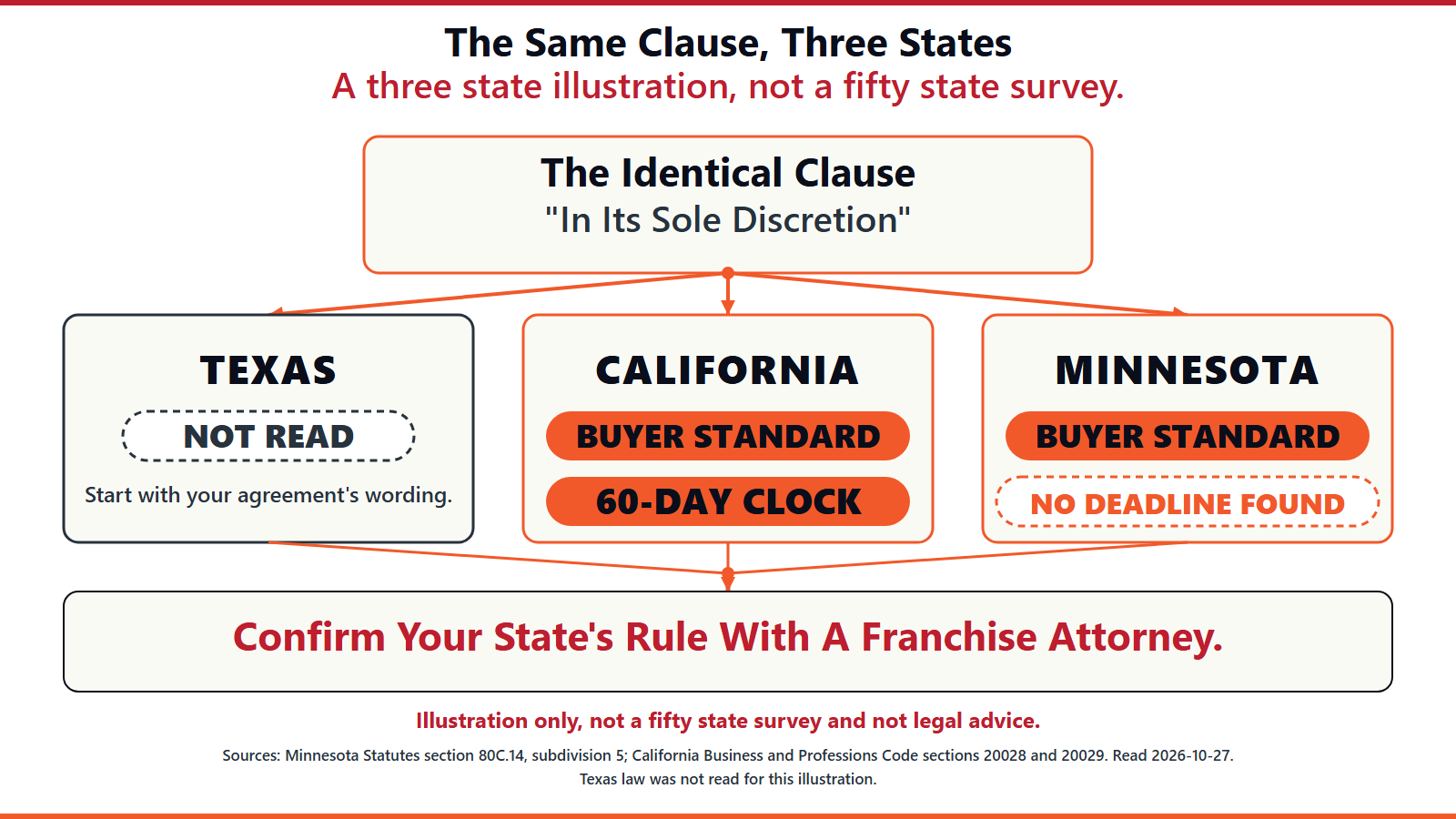
- Minnesota: the statute asks whether your buyer meets the franchisor's present qualifications and standards. We found no response deadline in the sections we read.
- California: Section 20028 sets the same kind of standard, and Section 20029 sets the 60-day clock.
- Texas: Texas is not on the list we worked from, and we did not read Texas law. We draw no conclusion about what a Texas franchisee can do. Where no relationship law of this kind applies, your agreement's wording is where to start.
This is a three-state illustration, not a survey of fifty. If your unit is in another state, we have not checked it at this level, and you should not assume it works like these three until someone reads your state's law.
What if my units are in more than one state?
List them by state before you list the business. A statute depends on where a unit is located and, in some states, on other factors, so a portfolio spread across states can have a different answer for each unit, including a different clock where a state sets one.
We found no source on how a franchisor handles a sale that spans several states. Ask your franchisor in writing how it approves each unit, and whether it reviews them one by one or together.
How do I find out which state law applies to my agreement?
Start with three things you control. Pull the transfer and consent clause and mark the "sole discretion" wording. Look at the rows of Item 17 of your Franchise Disclosure Document (FDD) that cover transfer and governing law: (k) "Transfer" by franchisee, defined, (l) franchisor approval of transfer by franchisee, (m) conditions for franchisor approval of transfer, (v) choice of forum and (w) choice of law (16 CFR 436.5(q), read on Cornell Law School's Legal Information Institute, 2026-10-26). Write down the state where each unit sits.
Then take all of it to a franchise attorney, early. Which state's law governs your unit, and what it changes about your clause, is a question about your own document, and your attorney is the right person to answer it. We are not. For the wider picture of what a franchisor reviews, see our article on franchisor approval to sell a franchise.
A free Opinion of Value shows you the worth side of a sale and commits you to nothing. It is a personal valuation page with a custom video walkthrough recorded by a senior advisor, free and with no card on file. Request your free Opinion of Value when you want a number to plan around. If you decide to sell, our sell a franchise page shows how we work with owners.
Frequently asked questions
No. The Minnesota text ties the refusal to a buyer who meets the franchisor's present qualifications and standards, and California Section 20028 uses the same idea. A buyer who does not meet the standards sits outside that protection. Your attorney can read the statute against your buyer's file.
Ask your attorney before you assume either way. California Section 20010 voids contract terms that waive the Act's protections. Whether that reaches a choice-of-law clause pointing to another state is a question for your attorney, and we found no decided case that settles it.
You can ask. We found no source on how often a franchisor answers in full or how long it takes. Ask in writing, keep the reply, and have your attorney read it before you rely on it.