



Item 20 Transfers: How a Broker-Managed Sale Shows Up in Your FDD
A departing franchisee can land in more than one place in your Item 20, depending on how the exit ends. A sale to a new owner that closes during the term is reported as a transfer in Table 2. A termination, a non-renewal, a reacquisition by you, or a closure is reported in Table 3. Item 20 transfers are the one outcome where the outlet carries on under a new owner who is not the franchisor. In our view a broker-managed sale makes that outcome more likely than an unmanaged exit does. No source we found measures it.
How does Item 20 report an outlet that changes hands, ends or closes?
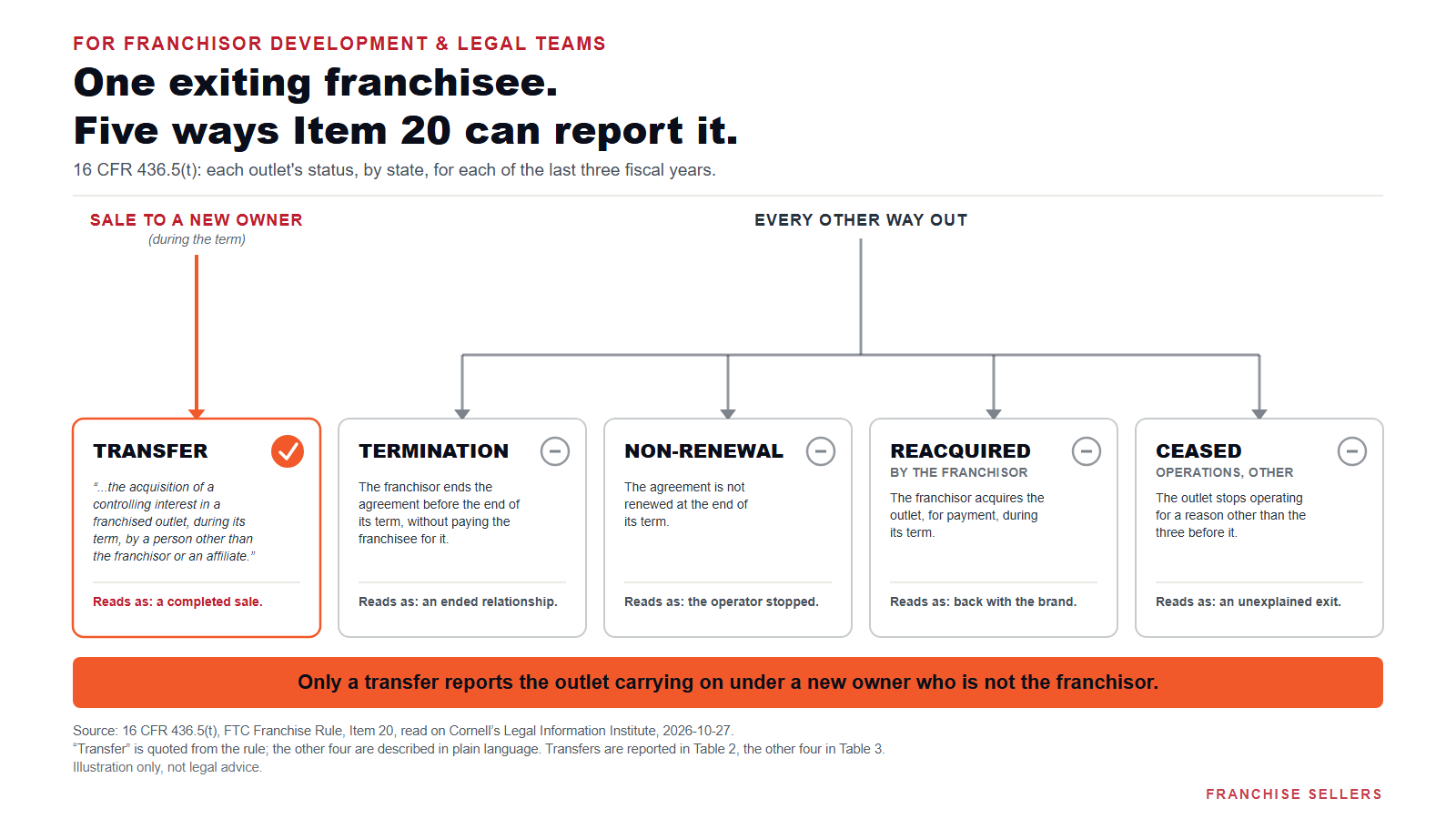
It sorts each outlet exit into one of five categories: transfer, termination, non-renewal, reacquisition by the franchisor, or ceased operations. The rule defines or describes each one, so the facts of the exit decide the category, not a label chosen afterward.
Here is what 16 CFR 436.5(t) says (read on Cornell Law School's Legal Information Institute, 2026-10-26; Cornell shows no currency date and is a reader copy, not the official text):
- Transfer. The rule says "transfer" means "the acquisition of a controlling interest in a franchised outlet, during its term, by a person other than the franchisor or an affiliate." It is reported in Item 20 Table No. 2, "Transfers of Outlets from Franchisees to New Owners (other than the Franchisor)."
- Everything else. Table No. 3, "Status of Franchised Outlets," carries the columns "Terminations," "Non-Renewals," "Reacquired by Franchisor" and "Ceased Operations-Other Reasons."
- Termination is the franchisor ending the agreement before its term expires, without providing any consideration to the franchisee. Non-renewal is an agreement not renewed at the end of its term. Reacquisition is the franchisor acquiring the outlet during its term for consideration. Ceased operations covers an outlet that stops operating as yours for a reason other than those three.
The rule asks for outlet data for each of your last three fiscal years, state by state.
Does Item 20 name the franchisees who left?
The tables count outlets, but a separate paragraph names people. Paragraph (t)(5) calls for "the name, city and state, and current business telephone number, or if unknown, the last known home telephone number of every franchisee who had an outlet terminated, canceled, not renewed, or otherwise voluntarily or involuntarily ceased to do business under the franchise agreement during the most recently completed fiscal year" and it also covers a franchisee who has not communicated with you within 10 weeks of the disclosure document's issuance date.
That paragraph does not mention transfers. We found nothing that says how it treats a franchisee who sold to a new owner and then stopped doing business under the agreement. That is a question for your franchise counsel, and we do not answer it.
Does the category an exit lands in matter to a prospective franchisee?
We found no source that measures how a prospective franchisee weighs Item 20 against the rest of the disclosure document. What follows is our reasoning, not a finding. A table that shows owners succeeding one another reads differently from one that shows a run of terminations and closures, and the second pattern is also the one that puts names and phone numbers on the (t)(5) list.
That is a reason to understand how exits end. It is not a reason to pick a category. The definitions above tie each category to what happened. For resale activity across the market, separate from your own Item 20 history, see our franchise market report quarter by quarter.
Can a broker-managed sale change which category an exit falls into?
It can change how the exit ends, and it changes nothing about the definitions or about your approval. This is Franchise Sellers' own reasoning. Nothing in the rule or the material we read measures it.
A transfer needs a completed acquisition of a controlling interest during the term. An exit run without help has more ways to miss that point. A sale that stalls can run into the end of the term and become a non-renewal. A franchisee who stops operating without finding a buyer can end up as ceased operations. A strained relationship can end in a termination. A sale that closes inside the term, with your consent, is a transfer.
We cover the consent step from the seller's side in our article on franchisor approval.
What does a broker-managed transfer involve on your side of the table?
Your team receives a file for a buyer who has already been screened, with the application paperwork assembled. Franchise Sellers helps the seller with buyer screening, due diligence, the franchisor-approval paperwork and the closing steps. The aim is that what reaches you is complete, so your review is of a buyer and not of a missing document.
None of this moves your decision. Your approval authority and your brand standards are unchanged. The coordinated process produces a fuller file for you to apply them to, and the consent decision stays where it sits.
What should your development team do with this?
Start with the three things you control. Compare your own record of how recent exits ended against the rule's definitions. Look at how your approval and consent process shapes whether a sale can close inside the term. Take any question about how a specific exit is classified, or about paragraph (t)(5), to your franchise counsel, who is the right person to read your disclosure document. We are not.
If you want to see how we run a resale from the franchisee's side without touching your approval, consider us your department for nationwide franchise resales.
Frequently asked questions
No. The rule defines a termination as the franchisor ending the agreement before its term expires without providing any consideration. A reacquisition is the franchisor acquiring the outlet during its term for consideration. They are separate columns in Table No. 3.
The definition turns on acquiring "a controlling interest." We found no rule text or guidance, in the pages we read, that says how that applies to a given partner buyout or ownership change. Ask your franchise counsel to apply it to the facts.
Your approval and consent process shapes how an exit concludes, because approval is part of every franchise resale. The category itself follows the rule's definitions of what happened, for example a termination being you ending the agreement. It is not a choice made after the fact.