



How Long Does It Take to Sell a Business? What Changes for a Franchise
How long does it take to sell a business? Published answers run from about 149 days for one unusually fast quarter to nine months or a year for a broader view, and they disagree because each measures a different window. If you own a franchise, your franchisor's approval of the buyer is one more step inside that clock. This article shows what each figure measures, what moves your own timeline, and where a franchise sale adds time.
Why do the published timelines for selling a business disagree?
Each figure measures a different window of the same market: one quarter, one year, a multi-year view, or a trade group's working estimate. They can all be accurate and still disagree, and none of them is a forecast for your sale.
- BizBuySell, Q3 2025 Insight Report: a median time on market of 149 days, which the report itself called the fastest pace since 2017. That is one quarter, not a baseline to plan around.
- BizBuySell, 2025 recap: a median time to close of 170 days across the year, from 163 days for retail to 223 for manufacturing.
- BizBuySell, Q2 2026 Insight Report, as reported by Small Business Trends on 2026-08-11: a median time on the market of 155 days for service businesses and a median time to close of 247 days for manufacturing.
- BizBuySell Learning Center: a general range of six to twelve months, with historical medians closer to 200 days.
- International Business Brokers Association (IBBA): the average sale takes nine months to a year, in the association's guidance to its own audience.
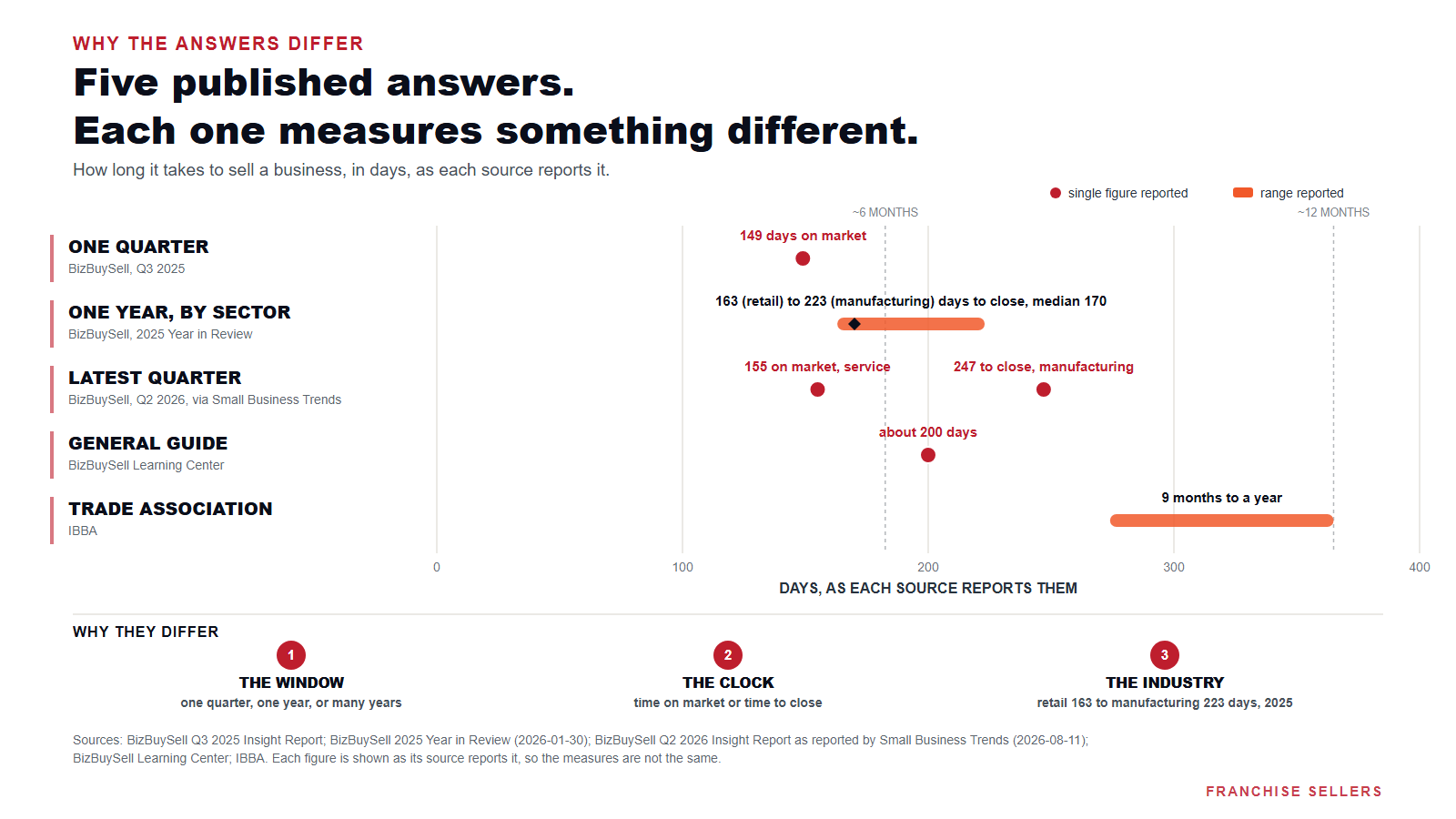
Two things most likely explain the spread. The first is the window, since a single quarter, a full year and a multi-year average will differ even when the market underneath is the same. The second is where the clock starts and stops. Days on market, the time it takes to find a buyer, and time to close, which adds due diligence, financing and closing, are probably different clocks. The six-to-twelve-month range most likely bundles both plus some preparation, and a single quarter's 149 days is more likely the narrower window from listing to an agreed deal.
Because the published figures do not always say where their clock starts and stops, read all five as ranges to plan against, not promises.
What makes one sale take longer than another?
Your industry, how the deal is paid for, and how ready your records are. You cannot change the first, and you can influence the other two.
- Industry. In BizBuySell's 2025 recap, median time to close runs from 163 days for retail to 223 for manufacturing. One blended national number hides that gap.
- Deal structure. A deal with seller financing or an earnout can take more negotiating than one paid in cash at closing.
- A buyer's lender. A buyer who borrows adds a lender's review before closing. How many days that adds depends on the lender and the deal, so ask early.
- Your records. Clean financials, documented add-backs and a valuation in hand mean the early stages are not spent assembling them.
What you control is the paper. Plan against the slower end of the range for your sector, and have your financials ready before you list. For market conditions quarter by quarter, see our franchise market report.
Does selling a franchise take longer than selling another business?
It can. The general timeline above still applies in full, and a franchise sale adds one step inside it: your franchisor has to approve your buyer.
Where does franchisor approval fit in the clock?
Franchisor approval happens after you have a buyer, not alongside the search for one. The franchisor approves a specific person, so the review can’t start until you have someone to put forward.
Approval is a term of your franchise agreement. The FTC's Franchise Rule makes the franchisor disclose it in Item 17 of the Franchise Disclosure Document (FDD), which has a row for whether approval is required and a row for the conditions (rows (l) and (m), 16 CFR 436.5(q), Cornell Law School's Legal Information Institute). How long approval takes varies from one franchisor to the next, so check what your agreement says, and ask your franchise attorney to read the timing language in your agreement. Our article on franchisor approval covers what a franchisor checks.
Can my franchisor still step in after I have a buyer?
If your agreement includes a right of first refusal, yes. The franchisor can take the deal on the same terms your buyer agreed to, which is one of the rows the FDD has to address (row (n) of the same item).
Not every agreement includes the clause, so check yours. A purchase agreement that is contingent on franchisor consent, with clear timing language, can help keep a late step-in from sending you back to the start.
What else should I ask my franchisor early?
The transfer fee and any remodel it would require. Your agreement sets the fee, and both the fee and the cost of bringing a location up to current brand standards vary from brand to brand. Read what your agreement says before you sign a purchase agreement, so you plan around it; the franchisor confirms both during the approval steps.
How do I get a realistic timeline for my own sale?
Start from your own business: its sector, how a buyer is likely to pay, and where you stand with your franchisor. Every sale with us starts with a free Opinion of Value: a value range for your franchise, based on our experience with franchise sales, on a personal valuation page with a video walkthrough prepared by Eric and our team. It is free, with no card on file, and getting one does not commit you to selling. Request your free Opinion of Value when you want to talk through timing for your sale.
If you are still on the fence on whether you want to sell at all, our article on getting out of a franchise agreement covers the options.
This is general information, not legal, tax or financial advice. Talk to your own attorney, CPA or lender about your situation.
Frequently asked questions
No. It was one quarter's median, and the report that published it called it the fastest pace since 2017. The 170-day year and the six-to-twelve-month range are safer to plan against, and your sector may sit above either.
It can, because a lender reviews the deal before closing, and an all-cash buyer skips that step. The days it adds depend on the lender and the deal, so ask the buyer early whether they are borrowing and how far along the lender is.
Each unit's transfer is governed by its own agreement, so whether they move together is set by your agreements and your franchisor. Ask whether the units are reviewed together or one at a time.